

Low quality leads can make a campaign appear busy while producing little commercial value. A business may receive hundreds of names, phone numbers, or email addresses but still struggle to reach suitable buyers, arrange conversations, or generate revenue. Weak data can waste budget, reduce sales productivity, and make campaign reports difficult to trust.
For companies that purchase calling data, email data, prospect lists, or customised databases, volume should never be the only measure of value. The useful question is how many records are accurate, relevant, reachable, properly sourced, and suitable for the intended campaign.
Table of Contents
What Makes a Lead Low in Value?
A weak lead is a record or enquiry with little realistic chance of becoming a customer. It may contain incorrect information, sit outside the target audience, lack buying authority, or show no relevant need. It may also be duplicated, outdated, poorly categorised, or supplied without enough source information. This is why lead quality matters more than lead quantity, as accurate and relevant contacts are more likely to support meaningful sales conversations.
Common Warning Signs
- Invalid telephone numbers
- Bounced email addresses
- Duplicate contacts
- Incorrect job roles
- Companies outside the selected industry
- Records from the wrong location
- Contacts without decision authority
- People who do not recognise the stated source
- Old records that no longer reflect the organisation
How Weak Data Reduces Marketing Return
Marketing return depends on the relationship between spending, sales activity, customers, and revenue. When the database is unreliable, every later stage becomes harder to manage.
It Raises the Real Cost per Contact
A low purchase price may appear attractive, but the stated cost per record does not show the full expense. Sales representatives may spend time calling wrong numbers, checking job roles, correcting details, and removing duplicates.
The true cost should include the database, verification, sales labour, campaign tools, and follow up. When only a small share of records can progress, the effective cost of each usable contact rises.
It Weakens Lead Generation ROI
A useful review should connect campaign expenditure with attributable revenue. Large data volume has limited meaning when only a small share can be contacted or assessed.
Businesses should compare:
- Total campaign cost
- Valid records
- Reachable contacts
- Suitable prospects
- Sales conversations
- Opportunities created
- Customers acquired
- Revenue attributed to the source
This shows whether the campaign produced business value rather than activity alone.
It Wastes Sales Capacity
Sales teams have limited time. When representatives repeatedly contact irrelevant or inaccurate records, they have fewer chances to speak with suitable buyers.
Salesforce describes lead qualification process as deciding whether a prospect is a suitable fit based on factors such as need, interest, finances, authority, and timing. A consistent assessment helps teams focus on contacts with a realistic chance of progressing.
It Distorts Reporting
Poor quality leads can inflate top level figures while hiding weak outcomes. A report may show thousands of contacts and high calling activity, yet conceal a low contact rate, weak suitability, and limited revenue.
The buyer and provider should agree on what counts as valid, reachable, relevant, accepted, replaced, and converted.
It Can Harm Brand Trust
Repeated calls to the wrong person, irrelevant messages, or communication based on unclear sourcing can create a negative impression.
The Information Commissioner’s Office states that personal data should be accurate and kept up to date where necessary. Its guidance also says organisations need an appropriate lawful basis and should consider compliance before beginning direct marketing.
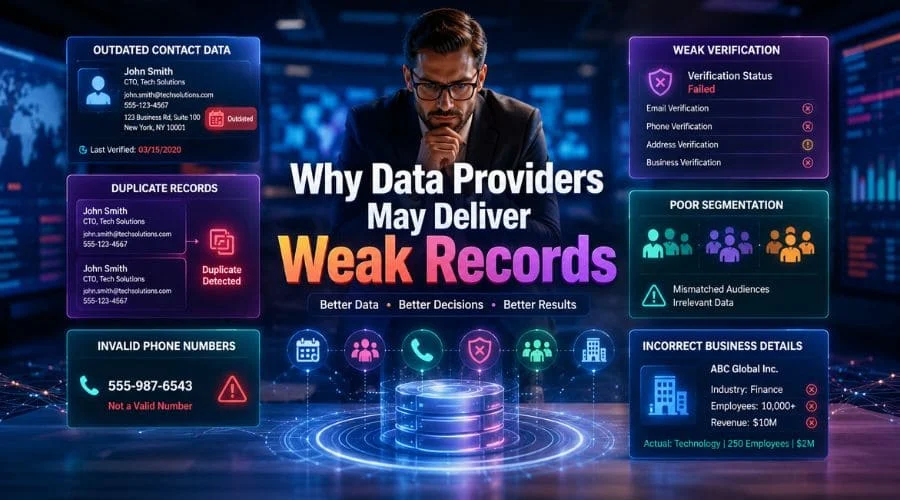
Why Data Providers May Deliver Weak Records
Campaign results also depend on the offer, response time, messaging, pricing, demand, and follow up. However, data issues often begin with collection, verification, segmentation, and maintenance, which makes choosing the right leads vendor an important part of campaign planning.
Outdated Information
Employees change roles, companies close, domains expire, and telephone numbers are reassigned. Buyers should ask when the information was collected, how often it is reviewed, and what the latest verification date represents.
Limited Validation
A formatting check is not the same as full validation. An email address may look correct but still be inactive. A telephone number may contain the right number of digits but belong to another person.
The checking method should match the campaign. Email outreach requires address validation, while calling campaigns require telephone accuracy and suitable location information.
Weak Segmentation
A large database can still be unsuitable when it uses broad categories. Industry, company size, job role, location, technology use, purchasing responsibility, and buyer intent data for B2B leads need clear definitions.
Precise segmentation helps the buyer select contacts connected to the campaign and reduces the screening burden on sales representatives.
Duplicate or Recycled Records
Duplicates can appear when several sources are combined without reliable matching. Repeated resale may also reduce response because the same people receive similar messages from several businesses.
Buyers should ask whether records are shared, exclusive, recently delivered elsewhere, or prepared for a specific request.
Unclear Sourcing
A provider should explain its broad collection methods. Buyers need enough information to judge relevance, accuracy, and lawful suitability.
ICO guidance notes that privacy duties can apply when business contact details identify an individual. Organisations using such details for direct marketing must provide relevant privacy information and follow applicable data protection requirements.
How to Measure Lead Quality
No single figure explains campaign performance. A useful review connects data accuracy, audience relevance, sales progress, and revenue.
Contact Rate
This shows the share of attempted records that result in a genuine connection.
Formula
Contact rate equals successful contacts divided by attempted records multiplied by one hundred.
Qualification Rate
This shows how many reached contacts meet the agreed criteria.
Formula
Qualification rate equals suitable contacts divided by contacts reached multiplied by one hundred.
Conversion Rate
This measures how many eligible contacts complete the intended outcome.
Formula
Conversion rate equals completed outcomes divided by eligible contacts multiplied by one hundred.
Cost per Suitable Prospect
This focuses on contacts that meet the agreed standard.
Formula
Cost per suitable prospect equals total campaign cost divided by suitable prospects.
Customer Acquisition Cost
This should include relevant marketing and sales costs, not only the database price.
Formula
Customer acquisition cost equals total acquisition spending divided by customers gained.
Revenue per Record
This can help compare suppliers, sources, and segments.
Formula
Revenue per record equals attributed revenue divided by records delivered.
How to Improve Lead Quality Before Outreach
A business can improve Low quality leads by defining exactly what it needs before requesting data. A precise brief gives the supplier clearer selection rules.
Define the Ideal Customer Profile
The profile should describe the organisations most likely to benefit from the offer. It may include industry, location, company size, turnover, technology use, operational need, and buying structure.
For individual contacts, the brief should specify department, seniority, job function, and purchasing responsibility.
Create a Lead Qualification Process
A lead qualification process gives marketing, sales, and the supplier a shared standard. It should define which conditions make a contact acceptable and which require rejection or further review.
Fit Criteria
- Correct industry
- Suitable company size
- Relevant location
- Appropriate department
- Required authority
- Compatible service need
Readiness Criteria
- Stated interest
- Current requirement
- Budget availability
- Decision timing
- Willingness to continue
Validate Records Before Launch
Buyers can review a sample, check duplicate levels, confirm available fields, and test a limited group of records. This can reveal irrelevant categories, missing details, and weak accuracy before the full campaign budget is committed.
Connect Sales Feedback With Data Selection
Sales representatives often find patterns that are not visible in the original file. A structured feedback method allows the buyer to refine future requests and helps the supplier understand which records are useful.
How to Evaluate a Data Provider
Choosing a supplier requires more than comparing price and volume. Understanding how to choose a B2B data provider means examining how the provider collects, verifies, filters, delivers, and supports its information.
Questions to Ask
- Where does the information come from?
- When was it last reviewed?
- How are telephone numbers and email addresses checked?
- How are duplicates identified?
- Can records be filtered by industry, role, location, and company size?
- Are contacts shared with other buyers?
- What compliance information is available?
- What happens when a record is invalid?
- Can a sample be reviewed?
- Which delivery formats are supported?
Warning Signs
A buyer should investigate further when a supplier:
- Promises unrealistic accuracy without explaining the method
- Cannot describe the age or source of records
- Focuses only on volume
- Avoids questions about replacements
- Uses vague segmentation categories
- Offers no sample or field description

How to Increase Lead Conversion Rate
Accurate records create a stronger starting point, but they do not guarantee a sale. To increase lead conversion rate, a business must also review response time, message relevance, offer strength, and follow up quality.
Match the Message to the Segment
Different industries and roles have different concerns. The message should reflect the contact’s responsibilities, likely needs, and level of awareness.
Track Every Source Separately
Each supplier, segment, and channel should have a distinct label in the customer relationship management system. Combining all records in one report makes source comparison difficult.
Review Sales Outcomes
Data decisions should consider accepted contacts, conversations, opportunities, customers, revenue, and rejection reasons. This helps distinguish between a data problem and a sales process problem.
Why High Quality Business Leads Can Offer Better Value
High quality business leads are not defined by price alone. Their value comes from accuracy, relevance, freshness, source clarity, and suitability for the campaign. Understanding the benefits of reliable data providers can help businesses select information that supports better targeting and more productive sales activity.
A smaller list of suitable contacts may generate more meaningful conversations than a large, unfiltered database. The better comparison is cost per usable contact, cost per suitable prospect, acquisition cost, and attributed revenue.
Frequently Asked Questions
What are low quality leads?
They are records or enquiries that are inaccurate, irrelevant, unreachable, duplicated, outdated, or unlikely to progress. They can increase sales effort and campaign cost while reducing the reliability of reports.
How do poor quality leads affect marketing return?
Poor quality leads create waste across verification, calling, email delivery, follow up, reporting, and sales activity. They may make the stated price per record appear low while raising the true cost of each suitable prospect.
What is the difference between a lead and a qualified contact?
A lead is any person or organisation identified as a possible prospect. A qualified contact has been assessed against conditions such as fit, need, authority, interest, budget, and timing.
How can a business improve its database?
It should define the ideal customer profile, request precise segmentation, validate contact details, remove duplicates, record rejection reasons, and share sales feedback with the supplier.
What should buyers check before purchasing data?
They should review sourcing, validation, age, fields, segmentation, duplicate controls, sharing terms, compliance information, replacement conditions, and sample availability.
Can fewer records produce better results?
Yes. A smaller database can offer stronger value when contacts are accurate, relevant, reachable, and suitable for the offer. Performance should be judged through sales progress and revenue, not volume alone.
What is a good qualification framework?
A good framework uses clear fit and readiness criteria, records decisions consistently, routes suitable contacts to sales, captures rejection reasons, and improves through measured outcomes.
How is lead generation ROI calculated?
Lead generation ROI compares the financial return produced by a campaign with its total cost. The business should define which costs and revenue are included and apply the same method across every source.
Which measures help compare providers?
Useful measures include contact rate, qualification rate, duplicate rate, bounce rate, wrong person rate, cost per suitable prospect, conversion rate, acquisition cost, replacement rate, and revenue per record.
Conclusion
Weak records drain marketing value when inaccurate, irrelevant, or outdated information consumes budget and sales time without producing meaningful opportunities. Buying more data rarely solves the underlying issue.
A dependable data strategy requires shared responsibility. The provider should supply relevant, transparent, and properly maintained information. The buyer should use clear targeting, suitable messaging, prompt follow up, consistent qualification, and accurate sales reporting. When both sides measure usable contacts, customers, and revenue, marketing decisions become more informed and campaign return becomes easier to assess.