
B2B Email Marketing Automation helps businesses maintain relevant communication with prospects after those contacts enter a marketing database. For companies that work with business databases, the quality of the source data matters as much as the workflow itself. Accurate email addresses, job roles, company details, industries, locations, and engagement information help determine who receives a message and what happens next.
B2B lead nurturing is the process of building relevance with suitable prospects until they are ready for a meaningful sales conversation. Targeted email marketing campaigns support this process by delivering more relevant messages based on audience segments, while CRM activity, qualification, behavior, and lead scoring help guide prospects through each stage of nurturing.
For a data-provider-focused business, the key idea is simple. Automation works better when the contact records behind it are accurate, current, segmented, and useful.
Table of Contents
What Is B2B Email Automation?
B2B email automation uses software, rules, prospect data, and engagement signals to manage business email communication with less manual effort. It can support education, follow-up, qualification, re-engagement, and routing while still leaving important sales conversations to people.
Automated email marketing differs from basic scheduled sending in that actions can change based on data or prospect behavior. Marketing automation for B2B can connect email activity with CRM records, lifecycle stages, and sales actions.
How an Automated Email Workflow Works
An automated email workflow usually starts when a contact meets defined conditions. The system can then check available fields, place the contact into a segment, send a relevant message, record engagement, and decide what action should follow.
A useful process may include:
• verified contact data
• email segmentation
• audience segmentation
• a defined email nurture sequence
• behavioral email triggers
• CRM updates
• qualification rules
• a clear sales handoff
Business Email Campaigns Versus a Basic Drip Sequence
B2B email marketing can include newsletters, educational communication, announcements, and direct outreach. An email drip campaign normally follows a fixed timing plan. More advanced automation can change the path according to clicks, form activity, important page visits, or other meaningful actions.
Why Automation Cannot Repair Poor Data
If a contact record contains an invalid email, old employer, wrong designation, or duplicate entry, even a well-planned campaign can lose relevance. Email nurturing campaigns therefore depend on database quality before automation begins.

Why Data Providers Matter in Automated Nurturing?
A B2B lead nurturing strategy should connect contact acquisition with ongoing communication. A business database may identify suitable prospects, but it does not by itself create engagement. The quality and source of first-party and third-party data can also influence how accurately prospects are segmented and approached.
Automated lead nurturing helps organize communication after contacts have been sourced or collected. B2B nurture email campaigns can then reflect industry, role, company size, location, lifecycle status, and observed interest. This makes prospect nurturing more relevant to the information available.
Data Provider Information That Supports Better Targeting
Useful business data may include:
• verified business email addresses
• company name and domain
• industry
• job title
• department
• seniority
• company size
• geography
• source information
• engagement information when available legitimately
Contact Verification and Data Freshness
Business information changes. Employees move between companies, titles change, and domains become inactive. Working with a reliable B2B and B2C data provider can help businesses access more current contact information, while regular data verification supports better lead management and cleaner CRM integration.
Responsible Data Use Still Matters
Businesses should understand how contact data was obtained and whether their intended use is permitted. They should also respect applicable privacy rules, consent requirements, suppression preferences, and unsubscribe requests. A database should support responsible marketing, not replace it.
How Email Automation for Lead Nurturing Works
Email automation for lead nurturing connects data, messaging, timing, and behavior.
Start With the Intended Customer Profile
Before creating any sequence, define the industries, locations, company types, roles, and seniority levels that matter. This provides a clear basis for database selection and segmentation.
Build a Lead Nurturing Workflow
A lead nurturing workflow should define what happens when a new contact enters, becomes engaged, becomes inactive, or reaches a qualification threshold.
A welcome email sequence may introduce the purpose of the communication. Later messages can provide useful information, answer common concerns, or respond to stronger interest. A lead nurturing email sequence should have a clear purpose at every stage.
Use Personalized Email Campaigns Carefully
Personalized email campaigns should reflect useful information about the recipient. Email personalization can consider role, industry, lifecycle status, or previous engagement instead of relying only on the first name. Dynamic email content can adjust selected message elements when the underlying data is reliable.
Use Triggered Communication When It Adds Relevance
Triggered email campaigns can respond to actions such as meaningful clicks, form submissions, content requests, or repeated visits to important pages. Automated follow-up emails can then keep communication timely without asking a marketer to review every record manually.
Nurturing Activity by Buyer Stage
| Buyer Stage | Useful Data | Email Goal | Automation Trigger | Recommended Next Action |
| New Contact | Industry, job role, company size, location | Establish relevance and introduce useful information | Contact enters the verified database or CRM | Begin the appropriate nurture sequence |
| Engaged Prospect | Email clicks, website visits, content activity | Build interest and provide relevant information | Repeated engagement with emails or website content | Send more specific educational content |
| Marketing Qualified Lead | Firmographic fit, engagement history, lead score | Assess buying readiness | Lead reaches the defined qualification score | Continue qualification or notify marketing |
| High Intent Lead | Service page visits, repeated clicks, enquiries, intent signals | Identify stronger purchase interest | Multiple high value actions within a defined period | Increase lead priority |
| Sales Qualified Lead | Strong fit, high engagement, qualification information | Prepare for direct sales communication | Sales readiness criteria are reached | Transfer the lead to sales |
| Inactive Lead | Previous activity, last engagement date, lifecycle status | Determine whether interest still exists | No meaningful engagement for a defined period | Start a re-engagement sequence |
Qualification, Scoring, and Sales Readiness
Lead scoring gives selected values to prospect characteristics and actions. It can combine profile fit with engagement so marketers do not rely on a single signal.
Behavioral lead scoring focuses on what a contact does, such as clicking relevant content, submitting a form, or returning to an important page. When paired with reliable firmographic data, it can support lead qualification and help businesses using B2B lead generation services identify which prospects are more ready for further nurturing or sales follow-up.

Moving From Marketing to Sales
Marketing qualified leads have met defined marketing criteria. MQL nurturing keeps communication active while more information is gathered.
Sales qualified leads have met the conditions for direct sales attention. MQL to SQL conversion should therefore represent improved readiness, not simply movement between database labels.
Signals That Can Support Lead Engagement Decisions
Useful signals can include:
• repeated meaningful clicks
• important page visits
• information requests
• form submissions
• continued interaction over time
• strong fit with the intended customer profile
Marketing and Sales Need Shared Rules
Marketing and sales alignment helps both teams agree on what readiness means. When definitions differ, sales may receive contacts too early or marketing may keep interested prospects too long.
Data Fields Used in Automation
| Data Field | Example | Segmentation Use | Automation Use | Nurturing Benefit |
| Job Title | Marketing Manager, Sales Director | Group contacts according to responsibilities | Send role-relevant messages | Makes communication more relevant |
| Job Title | Marketing Manager, Sales Director | Group contacts according to responsibilities | Send role relevant messages | Makes communication more relevant |
| Industry | Software, Finance, Healthcare | Create industry specific audience groups | Assign contacts to relevant sequences | Helps address sector specific needs |
| Company Size | Small Business, Mid Market, Enterprise | Separate prospects according to business size | Select suitable messaging and workflows | Improves audience relevance |
| Geography | India, USA, UK, Canada | Organize contacts by target market | Control regional messaging and timing | Improves geographic relevance |
| Seniority | Manager, Director, VP, C Level | Identify decision making authority | Adjust communication according to seniority | Supports better lead qualification |
| Department | Marketing, Sales, IT, Operations | Group prospects according to business function | Deliver department-focused content | Improves message relevance |
| Engagement Activity | Email clicks, form submissions, website visits | Separate active and inactive prospects | Trigger follow up actions | Supports timely communication |
| Lead Score | 30, 60, 90 | Group prospects according to qualification level | Change nurturing stage automatically | Helps identify sales readiness |
| Intent Signal | Repeated service page visits, information request | Identify prospects showing stronger interest | Increase lead priority or trigger follow up | Supports better qualification |
CRM and Lifecycle Automation
CRM email automation can connect prospect records with communication rules, ownership, task creation, and stage changes. A marketing automation platform can also coordinate forms, email activity, CRM information, and reporting.
Buyer journey automation organizes communication according to consideration stages. Customer journey automation covers a wider relationship after a contact moves beyond the prospect stage.
Lifecycle email marketing can assign different communication to leads, active opportunities, customers, or inactive contacts. Lifecycle stage automation can update a record when defined conditions are met.
Supporting the B2B Sales Funnel
Sales funnel automation can handle repetitive actions such as record updates, reminders, and routing. Within the B2B sales funnel, different contacts may require different information and timing.
Pipeline nurturing helps maintain relevant communication with prospects who remain suitable but need more time. Sales pipeline automation can also create tasks or update opportunity stages after selected actions occur.
Human Review Should Remain Part of the Process
Automation can organize actions, but people should review whether the rules still reflect actual customer behavior. Sales feedback can reveal whether the system is identifying genuinely useful prospects.
B2B Marketing Automation and Demand Development
B2B marketing automation connects several marketing activities through rules and shared data. B2B demand generation creates awareness and interest, while nurturing maintains useful communication after identifiable prospects enter the system.
Account-Based Marketing
Account-based marketing focuses activity on selected organizations and the people involved in their decisions.
ABM email campaigns may need accurate information for several contacts within the same company. Company matching, role data, seniority, and department information can help teams understand how those contacts relate to one account.
Why Company Level Data Matters
If several people from one organization enter a database, accurate account relationships help marketing and sales teams coordinate communication around the organization rather than treating each record as completely separate.
Measuring Nurturing Performance
Email campaign optimization should consider both engagement and movement toward meaningful business outcomes.
Email Open Rate
Email open rate can provide directional information, but it should not be treated as proof of interest because technical and privacy factors can affect tracking.
Click-Through Rate
Click-through rate shows whether recipients interact with links in the email. Its value increases when those links lead to content connected with buying intent.
Email Conversion Rate
Email conversion rate measures completion of the intended action. That action might be a form submission, information request, meeting request, or another defined step.
Lead Conversion and Pipeline Progress
Lead conversion should be measured according to a clearly defined goal, so teams know what progression actually means.
Measure Quality, Not Only Volume
High sending volume does not necessarily mean stronger performance. Database accuracy, relevance, response quality, progression, and sales feedback should be reviewed together.
Common Problems With Automated Nurturing
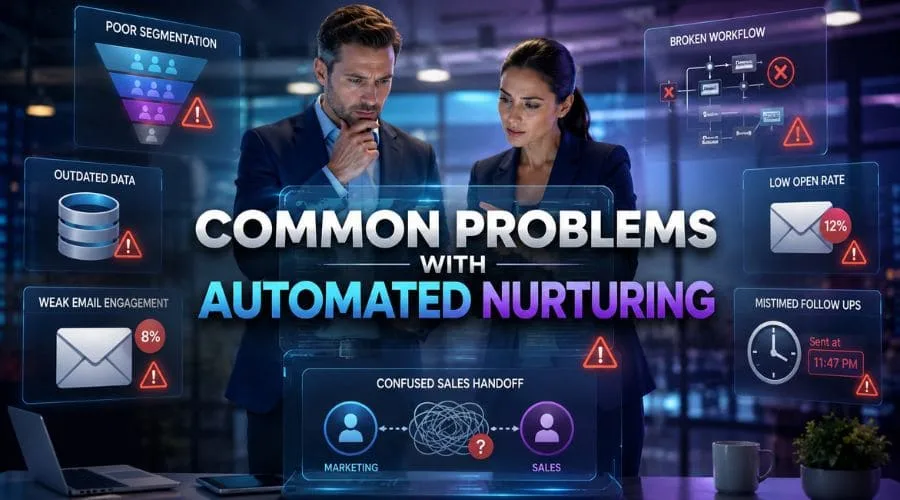
Even a sound email marketing automation strategy can perform poorly when contact data or workflow rules are weak, which is one of the main reasons why bought leads fail to generate meaningful engagement.
Common problems include:
• outdated records
• weak segmentation
• duplicate contacts
• excessive sending frequency
• unclear qualification criteria
• irrelevant content
• poor CRM ownership
• automation based on weak signals
Re-engagement and Follow-up
Re-engagement email campaigns can help determine whether inactive contacts still have a reason to receive communication.
Prospect follow-up automation can support consistent contact while respecting frequency, preferences, suppression rules, and previous activity.
Avoid Automating Every Interaction
Automation should support useful communication, not remove judgment. A prospect showing strong interest may benefit from a direct human conversation rather than another scheduled email.
Frequently Asked Questions
Q: What is email marketing automation for B2B prospects?
Ans: It is a system that combines business data, messaging rules, engagement activity, CRM records, and qualification criteria to manage communication with prospects at different stages of the buying process.
Q: How does automation support business lead nurturing?
Ans: It allows communication to respond to prospect data, stage, and behavior. Relevant contacts can receive useful information, while stronger engagement can trigger qualification or sales review.
Q: What data is needed for automated nurturing?
Ans: Useful data can include verified business email, company, industry, role, seniority, location, company size, lifecycle stage, source, engagement history, and legitimately collected intent information.
Ans: How is a drip sequence different from automated nurturing?
A drip sequence mainly follows predetermined timing. A broader nurturing system can change content, timing, or routing based on contact information, behavior, lifecycle status, and qualification rules.
Q: How should marketers use scoring?
Ans: Scoring should combine clear fit criteria with meaningful activity. The model should be reviewed against sales outcomes so that higher scores continue to represent stronger potential.
Q: When should a prospect move to sales?
Ans: A prospect should move when agreed readiness criteria are met. These may include profile fit, meaningful engagement, information requests, intent signals, and other actions that indicate a useful sales conversation is appropriate.
Q: How can data providers support nurturing?
Ans: Data providers can supply accurate, relevant, appropriately sourced business contact information and segmentation fields. The marketer remains responsible for lawful use, communication preferences, campaign purpose, and responsible outreach.
Q: How frequently should nurture emails be sent?
Ans: There is no single ideal schedule. Frequency should reflect the buying cycle, audience expectations, value of the content, previous engagement, and communication purpose.
Final Takeaway
B2B Email Marketing Automation performs best when reliable data supports every decision. Contact accuracy influences segmentation, personalization, routing, reporting, and the quality of sales conversations.
For the data provider industry, this creates a clear relationship between database quality and campaign quality. Accurate contact details help marketers identify the right audience. Useful firmographic fields help separate that audience into meaningful groups. Engagement information then helps the system decide what communication should follow.