
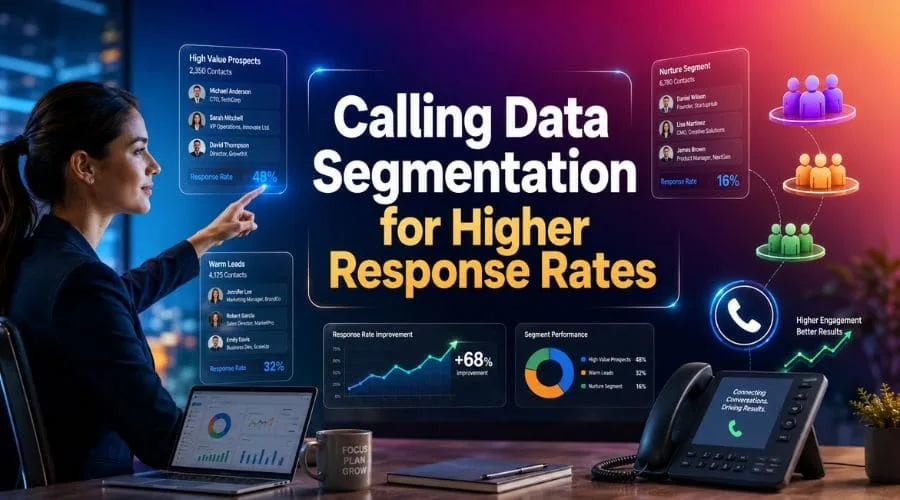
Calling campaigns often struggle because the same contact list, message, timing, and approach are used for every prospect. A business owner, a purchase manager, an individual consumer, and an inactive customer may appear in the same database, but they do not have the same needs or level of interest.
Calling Data Segmentation helps organise contacts into meaningful groups based on location, profile, behaviour, business information, purchase intent, and previous interactions. Calling teams can then use more relevant messages and prioritise contacts who are more likely to respond.
For data providers, segmentation is not simply an optional database feature. It determines whether the supplied information can support accurate targeting, useful conversations, and measurable campaign outcomes.
Table of Contents
What Is Calling Data Segmentation?
Data segmentation is the process of dividing a calling database into smaller groups using shared characteristics. These characteristics may include location, age, industry, job role, company size, customer status, purchase behaviour, or buyer intent.
Instead of contacting every person with the same script, a business can create different approaches for each audience group.
How Is Segmentation Different From Contact Filtering?
Basic filtering removes records that do not match a selected condition. Segmentation goes further by creating organised audience groups that can be used for messaging, prioritisation, timing, testing, and reporting.
For example, a filter may show all contacts from one city. A complete segmentation process may divide those contacts by city, industry, company size, decision maker role, interest level, and previous campaign activity.
Why Does Database Structure Matter?
A calling database must contain consistent fields before meaningful groups can be created. Industry names, locations, job titles, phone formats, and company categories should follow a common structure.
Poorly organised information may place similar contacts in different groups or unrelated contacts in the same group. A trusted data provider should therefore clean and standardise records before delivering them for campaigns.
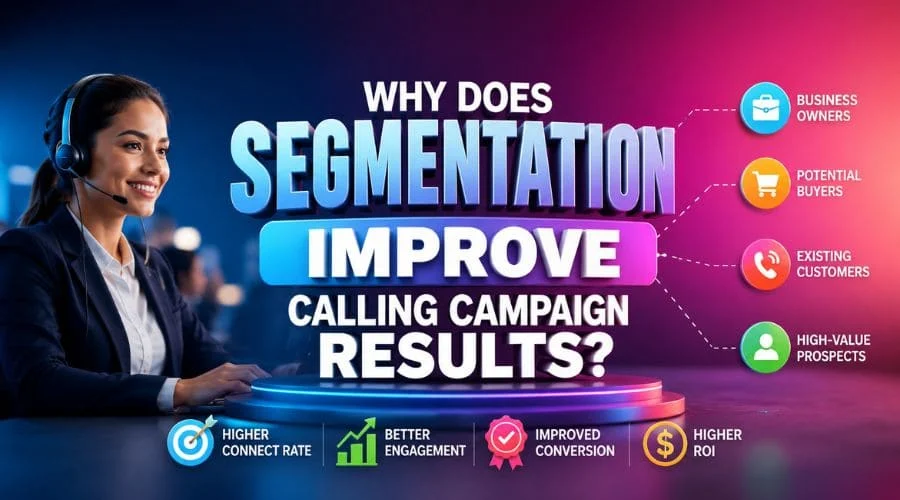
Why Does Segmentation Improve Calling Campaign Results?
People are more likely to continue a conversation when the caller understands their likely needs. Segmentation gives calling teams enough context to make the opening relevant without making the conversation sound intrusive.
It Creates More Relevant Conversations
A general script often discusses benefits that do not match the prospect. Segmented calling data allows the caller to refer to the contact’s industry, location, business size, role, or stage in the buying process.
This relevance can support higher response rates because the recipient can quickly understand why the call may matter.
It Helps Teams Prioritise Valuable Contacts
Not every contact has the same likelihood of responding. Some prospects may have recently requested information, visited a service page, attended an event, or interacted with previous communication.
Lead segmentation allows calling teams to contact interested prospects before inactive or poorly matched records.
It Reduces Unproductive Calling
Broad databases often include contacts who do not fit the offer, work in the wrong location, lack purchasing authority, or no longer use the listed number.
Accurate contact database segmentation reduces time spent on records that have little connection with the campaign objective.
It Supports Better Personalisation
Personalized calling campaigns do not require a completely different script for every person. The team can adjust the opening, key questions, value message, and follow-up process for each group.
Why Relevance Influences Call Engagement
Recipients usually decide quickly whether to continue a call. A clear reason for calling can create interest, while an unrelated introduction may lead to rejection.
The goal is not to mention every available data point. The goal is to use enough information to make the conversation useful.
Main Types of Calling Data Segmentation
Different campaigns require different grouping methods. Data providers should offer fields that allow buyers to create segments aligned with their audience and objectives.
Geographic Segmentation
Geographic grouping uses details such as country, state, city, district, postcode, time zone, or service area.
It is useful for local services, regional campaigns, territory planning, language selection, and calls that should occur during appropriate local hours.
Location Fields That May Be Used
• Country
• State or region
• City
• Postcode
• Calling time zone
• Service availability area
Demographic Segmentation
Customer data segmentation may use age group, income range, occupation, household type, education, or other relevant consumer information.
Only information collected and processed through appropriate methods should be used. Businesses should avoid intrusive assumptions or unnecessary personal details.
Firmographic Segmentation
Firmographic grouping is widely used with B2B calling data. It organises companies according to attributes such as industry, revenue, employee count, ownership type, location, or growth stage.
Common Firmographic Fields
• Industry category
• Company size
• Annual revenue range
• Employee count
• Business location
• Company type
• Operating markets
Behavioural Segmentation
Behavioural grouping uses actions taken by the contact. These actions may include form submissions, content downloads, previous enquiries, past purchases, email engagement, event attendance, or earlier calls.
This approach helps distinguish active prospects from records that have shown no recent engagement.
Buyer Intent Segmentation
Buyer intent information can indicate which contacts are researching a subject, comparing options, or interacting with content related to a service. When combined with accurate company and contact information, intent signals can help calling teams decide who should be contacted first.
As a result, buyer intent data improves B2B lead quality by helping teams prioritize prospects who are more likely to engage in meaningful business conversations.
Lifecycle Segmentation
Lifecycle groups may include:
• New prospects
• Qualified leads
• Existing customers
• Repeat customers
• Inactive customers
• Lost opportunities
• Contacts requiring follow-up
Each group requires a different call objective. A new prospect may need information, while an existing customer may need support, renewal communication, or an additional service.
Lead Quality Segmentation
Calling lists can be classified as high interest, moderate interest, or low interest based on profile fit, recorded behaviour, and AI lead scoring.
Prospect segmentation should use clear and measurable rules rather than assumptions made by individual callers.
Technographic Segmentation
Technographic information identifies software, platforms, devices, systems, or business technologies used by an organisation.
This category may be useful when the suitability of a product depends on the technology already used by the prospect.
| Segmentation Type | Data Fields Used | Best Suited For | Expected Campaign Benefit |
| Geographic | Country, state, city, postcode | Local and regional campaigns | Better location relevance |
| Demographic | Age, income, job role | Consumer calling campaigns | More personalised communication |
| Firmographic | Industry, size, revenue | B2B calling campaigns | Better account targeting |
| Behavioural | Past actions and interactions | Follow-up campaigns | More relevant conversations |
| Buyer Intent | Search and engagement signals | High priority campaigns | Higher likelihood of response |
| Lifecycle | New, active or inactive contacts | Retention and reactivation | Better campaign timing |
| Lead Quality | Hot, warm and cold prospects | Sales prioritisation | Improved team productivity |
| Technographic | Software and technology usage | B2B technology campaigns | Better offer relevance |
Calling Data Segments and Their Uses
A targeted lead database may combine several categories. For example, a campaign could focus on decision makers from a selected industry, within a chosen region, working for companies of a specific size, who have also shown recent interest.
How Do Data Providers Prepare Segmented Calling Data?
A reliable segmentation process begins before the data reaches the calling team. Data providers must collect, verify, organise, classify, and update information according to defined quality standards.
Data Collection
The provider should know where the information came from, when it was collected, and which fields are available. Source transparency helps buyers understand whether the database suits their intended campaign.
Data Cleaning and Standardisation
Data cleaning may include:
• Correcting formatting differences
• Standardising location names
• Organising industry categories
• Normalising job titles
• Removing incomplete entries
• Checking required fields
A campaign-ready calling data file should be easy to sort, filter, upload, and review.
Duplicate Removal
Duplicate records increase calling costs and may cause the same person to receive repeated calls. They can also distort campaign reports by making the database appear larger than it is.
Providers should compare phone numbers, email addresses, company names, contact names, and other identifiers when checking duplicates.
Phone Number Verification
A phone number may be correctly formatted but no longer active. Verification methods can help identify invalid, incomplete, or unsuitable records before a campaign begins.
Verified targeted calling data cannot guarantee a response, but it can reduce preventable failures caused by poor contact information.
Data Enrichment
Data enrichment adds useful fields to existing records. A provider may add industry, company size, role, location, technology usage, or interest information when those details come from permitted and reliable sources.
Why Data Freshness Matters
People change jobs, companies relocate, numbers are disconnected, and business information changes. The calling database segmentation becomes weaker when the underlying records are old.
Providers should explain how frequently their information is checked and what an update means within their process.
Which Data Fields Should Be Used?
The right fields depend on the campaign. Collecting more information does not automatically produce better results. Every selected field should support targeting, personalisation, qualification, or reporting.
Contact Information
Useful contact fields may include:
• Full name
• Phone number
• Email address
• Job title
• Department
• Preferred language
Business Information
For business campaigns, useful fields may include industry, company size, revenue range, employee count, location, website, decision maker role, and technology use.
Interaction Information
Campaign records can include the original lead source, date collected, previous call outcome, enquiry topic, follow-up status, last interaction date, and recorded preferences.
Intent Information
Intent fields may include content interaction, enquiry activity, product interest, event participation, research behaviour, or other signs of possible demand.
Essential Fields for Consumer Campaigns
Consumer data should focus only on information relevant to the offer and permitted by applicable rules. Excessive personal detail can create privacy concerns and may make conversations uncomfortable.
How to Segment Calling Data Step by Step
Step 1: Define the Campaign Objective
Decide what the calling team should achieve. The objective may be qualification, appointment booking, renewal, reactivation, feedback, or introduction of a relevant service.
Step 2: Describe the Intended Audience
Identify the people or organisations that are most likely to need the offer. Consider location, profile, business type, role, budget range, and level of interest.
Step 3: Choose Relevant Data Fields
Select fields that directly support the audience definition. Avoid using every available field simply because it exists.
Step 4: Clean and Verify the Records
Check formatting, duplicate entries, missing values, inactive numbers, and inconsistent categories before creating groups.
Step 5: Create Clear Segments
Each group should have a clear reason for existing. Calling list segmentation becomes difficult to manage when groups overlap without purpose.
Step 6: Match Communication With Each Group
Adjust the call opening, questions, value message, objection handling, and desired action according to the audience.
Step 7: Prioritise Contacts
Place recent enquiries, strong profile matches, and relevant intent signals higher in the calling queue.
Step 8: Measure Results Separately
Track each segment independently. Combined reporting may hide the difference between strong and weak audience groups.
Step 9: Update the Database
Review classifications after calls. New information from conversations can improve future sales data segmentation.
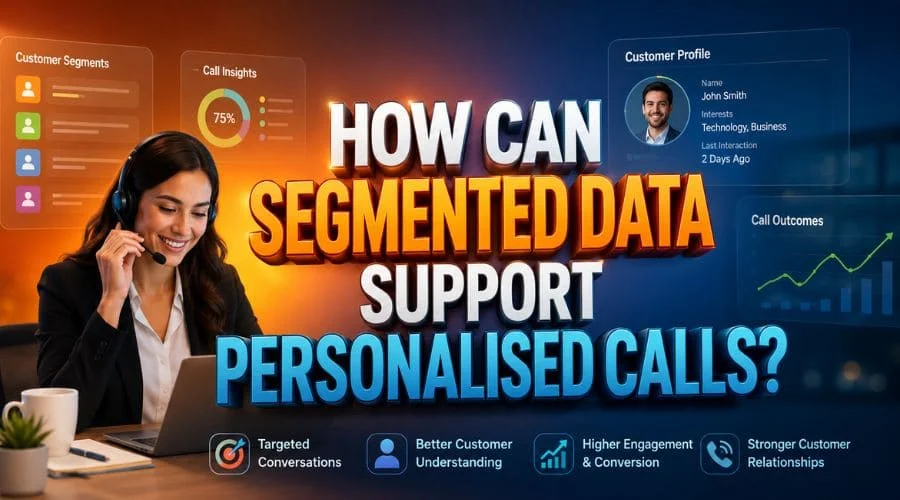
How Can Segmented Data Support Personalised Calls?
Segmentation should guide the conversation without making it rigid. Callers still need to listen and respond to the individual.
Adjust the Opening
A local prospect may receive a location-based introduction. A business decision maker may receive an industry-focused reason for the call. An existing customer may receive an acknowledgement of the current relationship.
Adjust the Questions
Questions should reflect the likely needs of the segment. New contacts may need broad qualification questions, while active prospects may be ready to discuss requirements, timing, or decision criteria.
Adjust the Call Timing
Time zone, work schedule, lifecycle stage, and previous activity can help determine when a contact is more likely to answer.
Adjust the Follow-Up Process
Different groups may require different follow-up frequencies and content. A recent enquiry may require faster contact than a general awareness prospect.
| Audience Segment | Segment Suggested Call Approach | Useful Personalisation Data | Primary Goal |
| High intent prospects | Direct and solution-focused | Recent interest signals | Generate qualified enquiries |
| Industry specific B2B leads | Sector relevant communication | Industry, company size and role | Improve business relevance |
| Local prospects | Location based introduction | City, region and service area | Build local connection |
| Existing customers | Relationship focused communication | Purchase history and preferences | Cross sell or retain |
| Inactive contacts | Reengagement focused message | Last interaction date | Restore interest |
| New prospects | Educational and needs based approach | Lead source and profile data | Start a relevant conversation |
| Decision makers | Business outcome focused message | Job title and company data | Support faster qualification |
| Price sensitive prospects | Value-focused communication | Previous objections or behaviour | Address cost concerns |
Segments and Calling Approaches
Scripts do not need to be rewritten completely for every audience. A core structure can remain consistent while selected questions, benefits, and next actions are adjusted.
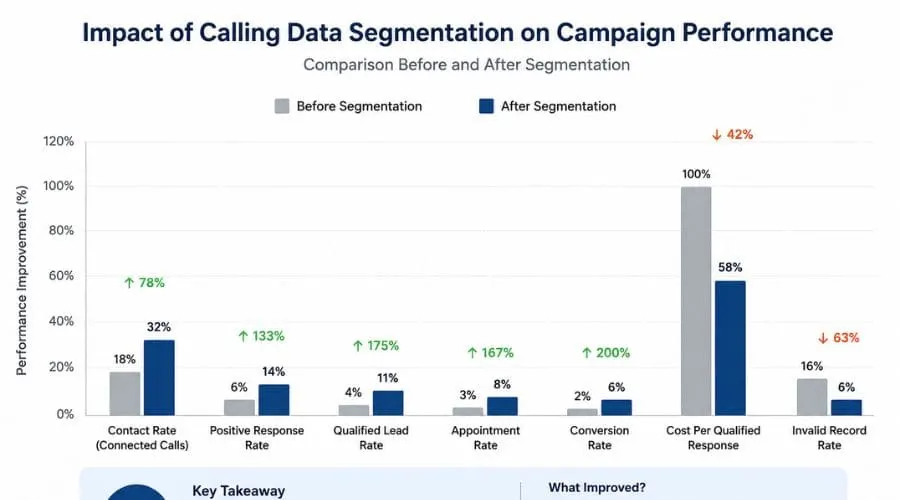
Case Study: Improving a Broad Calling Campaign
Campaign Background
A business purchased a broad database containing contacts from several industries, regions, company sizes, and job roles. The calling team used the same introduction and qualification questions for every record.
Problems Before Segmentation
The campaign experienced:
• Low connection quality
• Calls to unrelated industries
• Contacts without purchasing authority
• Repeated records
• Outdated phone information
• Limited understanding of prospect interest
• Long calling hours with few qualified conversations
Segmentation Process
The database was cleaned and grouped by location, industry, company size, decision maker role, previous interaction, and recorded interest.
Telemarketing data segmentation was then used to create separate calling queues for strong profile matches, moderate matches, previous enquiries, and inactive contacts.
Communication Changes
The team created different opening statements for each industry group. Decision makers received questions about business requirements, while previous enquiries received follow up calls connected to their earlier interest.
Calling times were also adjusted according to location and contact type.
Illustrative Results
After the changes, the campaign recorded an illustrative increase in connected conversations and qualified responses. Calls to poorly matched records decreased, and the team spent more time speaking with relevant contacts.
These figures were used only for internal comparison. Actual results depend on data accuracy, offer relevance, team capability, calling time, compliance, and market conditions.
What Can Data Providers Learn?
Data providers should not treat record volume as the only measure of value. Well-organised fields, accurate categories, recent verification, and useful filtering options can make a smaller database more practical than a large unclassified file.
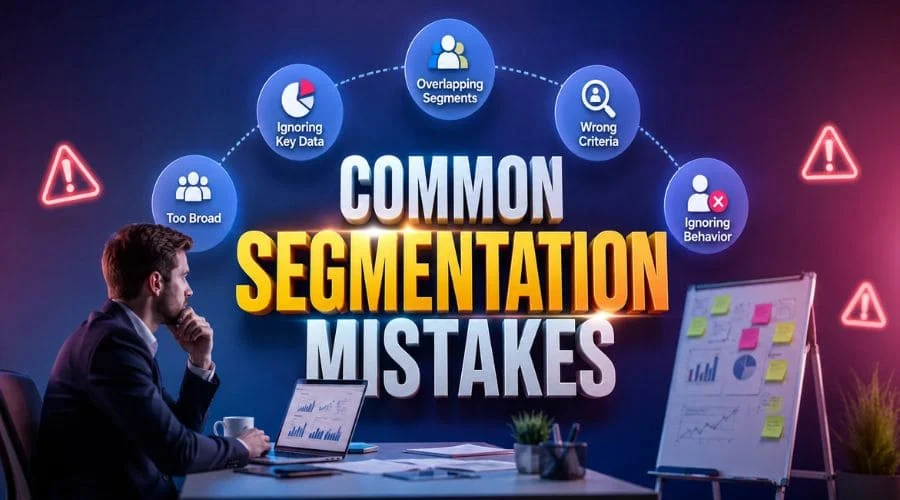
Common Segmentation Mistakes
Using Outdated Records
Old information may place contacts in the wrong company, industry, location, or lifecycle group, which is one of the main reasons why bought leads fail.
Creating Groups That Are Too Broad
A group labelled as business owners may contain companies with completely different needs, budgets, and decision processes.
Creating Too Many Groups
Very small segments may make reporting and script management difficult. Every group should support a meaningful campaign decision.
Ignoring Buyer Intent
Profile fit alone does not show whether someone is currently interested. Intent information can support prioritisation when it is accurate and interpreted carefully.
Depending on One Field
A single field rarely gives enough context. Industry information may become more useful when combined with company size, role, location, and activity.
Using One Script for Every Group
Data-driven telemarketing requires communication that reflects why each audience was selected.
Ignoring Compliance
Segmentation does not remove legal, consent, privacy, or calling preference obligations. Businesses should obtain guidance suited to their location and campaign.
How Should Campaign Performance Be Measured?
Measuring the entire campaign as one group may hide useful insights. Compare segments using the same time period, team conditions, and campaign objective.
Important Metrics
• Contact rate
• Positive response rate
• Qualified lead rate
• Appointment rate
• Conversion rate
• Calls required for each qualified lead
• Follow-up response
• Invalid record rate
• Duplicate rate
• Cost for each qualified response
Response Rate Formula
Call Response Rate = Positive Responses ÷ Connected Calls × 100
A segment with fewer contacts may still be valuable when it produces better conversations and stronger qualifications.
Privacy and Responsible Data Use
Businesses should know how records were collected, what permissions apply, how recent the information is, and whether calling preferences are available.
Questions to Ask a Data Provider
• Where was the information collected?
• When was it last checked?
• Which verification methods are used?
• Can records be filtered by location, industry, role, and interest?
• How are duplicates identified?
• How are calling preferences handled?
• What happens when a record is inaccurate?
• Which fields are included in the final file?
Customer profiling should remain relevant, proportionate, and respectful. Personalisation should help the recipient understand the call, not make them feel observed.
Frequently Asked Questions
Q: What is segmented calling data?
Ans: It is a contact database divided into smaller groups according to shared characteristics such as location, industry, company size, role, behaviour, or level of interest.
Q: How can segmentation improve call response rates?
Ans: It helps calling teams contact more suitable prospects, use relevant messages, prioritise stronger opportunities, and reduce calls to poorly matched records.
Q: What is called database segmentation?
Ans: It is the process of organising a calling database into usable audience groups for targeting, communication, prioritisation, and performance measurement.
Q: What is audience segmentation for calling campaigns?
Ans: It means dividing the intended audience according to characteristics that affect how and why they should be contacted.
Q: Is calling list segmentation suitable for small campaigns?
Ans: Yes. Even a small campaign can benefit from separating contacts by location, interest, customer status, or business type.
Q: What is the difference between segmentation and lead scoring?
Ans: Segmentation places contacts into groups. Lead scoring assigns a value or rank based on profile fit, behaviour, or likelihood of progressing.
Q: How often should calling data be updated?
Ans: The update frequency depends on the industry and data type. Fast changing business information may require more frequent verification than stable location information.
Q: Can a data provider guarantee campaign results?
Ans: No. A provider can support accuracy, relevance, organisation, and verification, but results also depend on the offer, market demand, calling team, timing, and sales process.
Q: What makes targeted calling campaigns effective?
Ans: They combine accurate contact information, clear audience selection, suitable communication, responsible calling practices, and consistent performance measurement.
Q: How should a business choose a data provider?
Ans: It should review data sources, verification methods, available fields, update practices, filtering options, duplicate controls, compliance procedures, and accuracy policies.
Conclusion
Calling Data Segmentation helps businesses replace broad calling activity with more focused communication. It allows teams to organise prospects according to meaningful characteristics, adapt conversations, prioritise stronger opportunities, and measure results more accurately.
For data providers, the value of a database depends on more than the number of records. Accuracy, freshness, classification, verification, useful data fields, and responsible processing all influence campaign usability.
Businesses should combine relevant profile information, behaviour, buyer intent, lifecycle status, and past interactions where appropriate. They should also review every group regularly as new information becomes available.
A well structured database cannot guarantee success, but it gives calling teams a clearer foundation for relevant conversations, efficient targeting, and informed campaign decisions.