
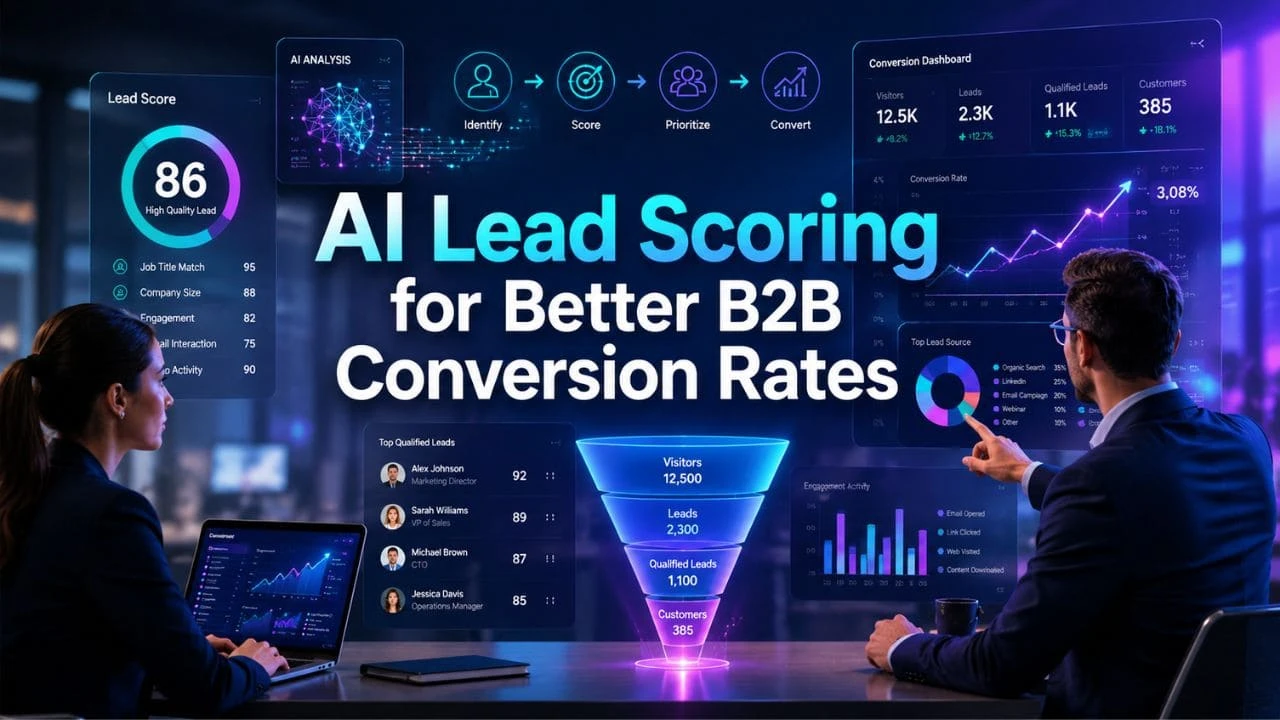
In B2B marketing, getting more leads is not always the real challenge. The bigger challenge is knowing which leads are worth calling, emailing, nurturing, or sending to the sales team first. This is where AI lead scoring becomes useful. It helps businesses study lead behaviour, company details, engagement signals, and past sales patterns to understand which prospects are more likely to convert.
For companies that depend on B2B data, calling campaigns, email marketing, and sales outreach, better lead ranking can save time and improve follow-up quality. Instead of treating every contact the same, teams can focus on prospects that show stronger interest and better business fit.
The goal is simple: spend less time on weak leads and more time on opportunities that can move through the sales process.
Table of Contents
What Is AI-Based Lead Scoring?
AI-based lead scoring is the process of ranking leads with the help of data, automation, and machine learning. It studies different signals such as website visits, form submissions, email activity, company size, job role, call response, and past buying behaviour. As AI and the changing B2B sales process continue to reshape how businesses identify and engage prospects, lead scoring has become more accurate and data-driven.
Traditional scoring often depends on fixed rules. For example, a lead may get points for opening an email or visiting a pricing page. AI-based scoring goes further by finding patterns that humans may miss. It can compare new leads with past converted customers and estimate how likely they are to become customers.
Why Lead Ranking Matters in B2B
B2B sales are usually more complex than direct consumer sales. A business buyer may need time to compare vendors, discuss budgets, get approval, and check service fit. That means a sales team needs to know where each lead stands.
A lead that downloaded a general guide may not be ready for a sales call. But a lead that visited a service page, filled out a form, and responded to a campaign may deserve faster attention.
Good scoring helps teams understand this difference.
How B2B Lead Scoring Helps Sales Teams
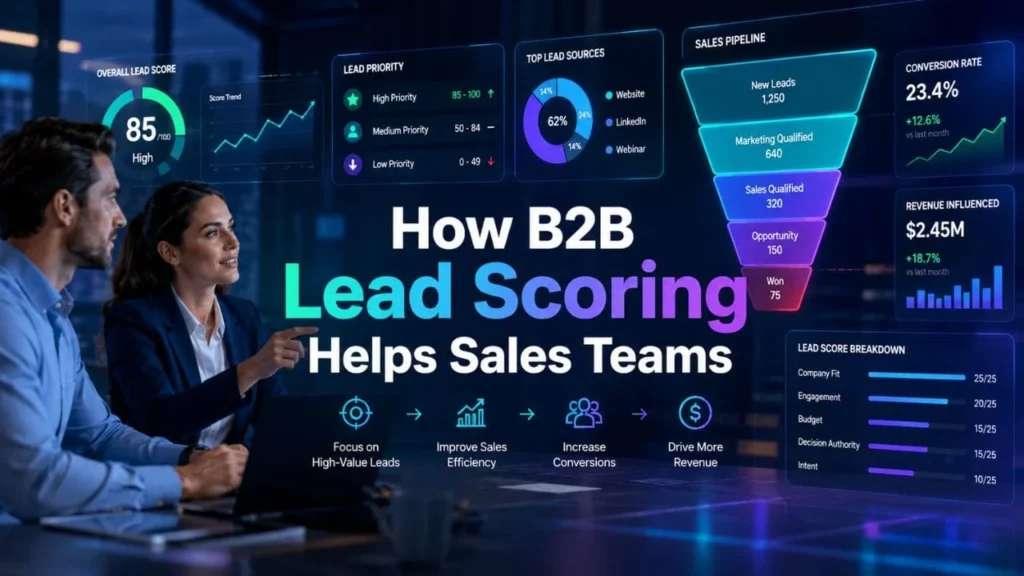
B2B lead scoring gives structure to the sales process. It helps sales and marketing teams agree on what a good lead looks like. Without a clear scoring method, marketing may send too many unqualified contacts to sales, and sales may waste time chasing people who are not ready.
With a proper scoring approach, businesses can identify leads based on:
- Company fit
- Industry relevance
- Decision-making role
- Engagement level
- Buying signals
- Past interaction history
- Campaign source
- Response behaviour
This makes the sales process more practical and less dependent on guesswork.
Common Lead Scoring Signals
| Lead Signal | What It Means | Possible Sales Action |
|---|---|---|
| Service page visit | The lead may be researching a solution | Send a relevant follow-up |
| Form submission | The lead has shown direct interest | Call or email quickly |
| Email click | The lead is engaging with your message | Add to active follow-up list |
| Company email used | The lead may be more serious | Check business fit |
| Repeated website visits | The lead may be comparing options | Assign higher priority |
| No engagement | The lead may not be ready | Add to nurturing campaign |
| Target industry match | The lead fits your ideal customer profile | Move forward for review |
| Recent enquiry | The need may be active | Follow up immediately |
Why Businesses Need Better Lead Qualification
Lead qualification is the process of checking whether a prospect is a good fit for your product or service. It usually considers budget, need, authority, timing, industry, location, and business type.
Without qualification, a sales team may contact every lead with the same effort. This creates delays and reduces productivity. Some leads may never respond, while better leads may be contacted too late.
A stronger qualification process helps businesses answer important questions:
- Is this lead from a relevant industry?
- Does the company match the target profile?
- Has the lead shown real interest?
- Is the contact person connected to decision-making?
- Has the lead responded to earlier campaigns?
- Is the lead ready for sales, or does it need nurturing?
When qualification improves, sales teams can focus their energy where it matters most.
AI and the Changing B2B Sales Process
The role of artificial intelligence in sales is growing because sales teams now handle more data than before. A company may receive leads from website forms, paid ads, calling data, email campaigns, LinkedIn outreach, chat tools, and CRM systems.
It is difficult for humans to study all these signals manually. AI helps by organising the data and finding useful patterns. AI lead scoring for B2B conversion rates uses these insights to identify which actions usually happen before a lead converts and which behaviours often indicate low interest.
For example, a lead that opens several emails, visits the same service page multiple times, and submits a business email may be more valuable than a lead that only clicks one blog link.
AI-Powered Lead Scoring and Human Judgement
AI-powered lead scoring does not mean sales teams should stop using human judgement. The best results come when technology supports people, not when it replaces them.
AI can help rank and filter leads, but sales teams still need to understand context. A lead may have a low score because it has limited activity, but the company may still be valuable. On the other hand, a lead may have a high score because of strong engagement, but the budget or decision-making authority may be weak.
That is why scoring should support decisions instead of becoming the only decision-maker.
Human Review Still Matters
Sales teams should regularly review the scoring results. They should check whether high-scoring leads are truly converting and whether low-scoring leads are being missed. Feedback from real calls, emails, and meetings can improve future scoring accuracy.
Traditional Scoring vs AI-Based Scoring
Traditional scoring can still be useful, especially for small teams. But it may not adjust well when buyer behaviour changes. AI-based scoring can study more data and update patterns over time.
| Factor | Traditional Scoring | AI-Based Scoring |
|---|---|---|
| Scoring style | Fixed rules | Pattern-based ranking |
| Data used | Basic engagement data | CRM, behaviour, fit, and intent signals |
| Flexibility | Limited | More adaptive |
| Setup | Easier to start | Needs quality data |
| Accuracy | Depends on manual rules | Improves with better records |
| Best use | Simple campaigns | Complex B2B sales process |
| Main benefit | Basic prioritisation | Better lead quality review |
Role of Predictive Scoring in B2B Sales
Predictive lead scoring uses past customer data to estimate which new leads are more likely to convert. It looks at patterns from previous sales, such as which industries closed faster, which job roles responded better, or which campaign sources produced stronger opportunities.
This approach is useful because sales teams often have historical data sitting inside a CRM but do not use it fully. AI can study this information and turn it into lead ranking insights.
How Predictive Scoring Works
A predictive system may look at:
- Past won deals
- Lost opportunities
- Lead source
- Industry category
- Contact role
- Company size
- Email engagement
- Call response
- Website activity
- Sales cycle length
Then it compares new leads with past patterns. If a new lead resembles those that have converted earlier, it may receive a higher score.
Data Needed for a Strong Scoring Process
Good scoring depends on good data and verified B2B data. If the data is incomplete, outdated, or inaccurate, the score may also become weak.
For example, if a CRM has duplicate contacts, missing industries, wrong phone numbers, or outdated email addresses, it becomes harder to judge lead quality. This is why data hygiene is important.
Important Data Categories
Firmographic Data
This includes company size, industry, location, revenue range, and business type. It helps teams understand whether the company matches their target audience.
Behavioural Data
This includes website visits, page views, downloads, form submissions, webinar sign-ups, and repeat activity. It shows how interested the lead may be.
Engagement Data
This includes email opens, clicks, replies, call responses, chat activity, and meeting requests. It helps measure how actively the lead interacts with your brand.
Intent Data
Buyer intent data helps identify whether a prospect may be researching a product or service. This can include pricing page visits, comparison searches, enquiry activity, and service-related behaviour.
Customer Data and Lead Accuracy
Customer data analysis helps businesses understand what their best customers have in common. This can include industry, company size, location, budget level, enquiry source, or engagement pattern.
By studying existing customers, companies can define stronger scoring rules. For example, if most converted customers come from a specific industry or region, similar future leads can be reviewed more carefully.
However, businesses should avoid relying on one signal alone. A lead should not score high only because it belongs to a target industry. It should also show interest, engagement, and potential need.
Building a Lead Scoring Model
A lead scoring model is a framework that decides how leads are ranked. It may include points, rules, predictive patterns, or a mix of all three.
A basic model may give points for:
- Visiting an important page
- Filling out a form
- Using a company email
- Matching a target industry
- Opening campaign emails
- Responding to calls
- Requesting pricing
- Returning to the website
A more advanced model may use AI to weigh these signals differently. For example, a pricing page visit may matter more than a blog visit. A reply to a sales email may matter more than an email open.
What Makes a Good Model?
A good model should be:
- Simple enough for teams to understand
- Based on real conversion data
- Connected with sales feedback
- Updated regularly
- Focused on lead quality, not just activity
- Linked with business goals
Choosing the Right Lead Scoring System
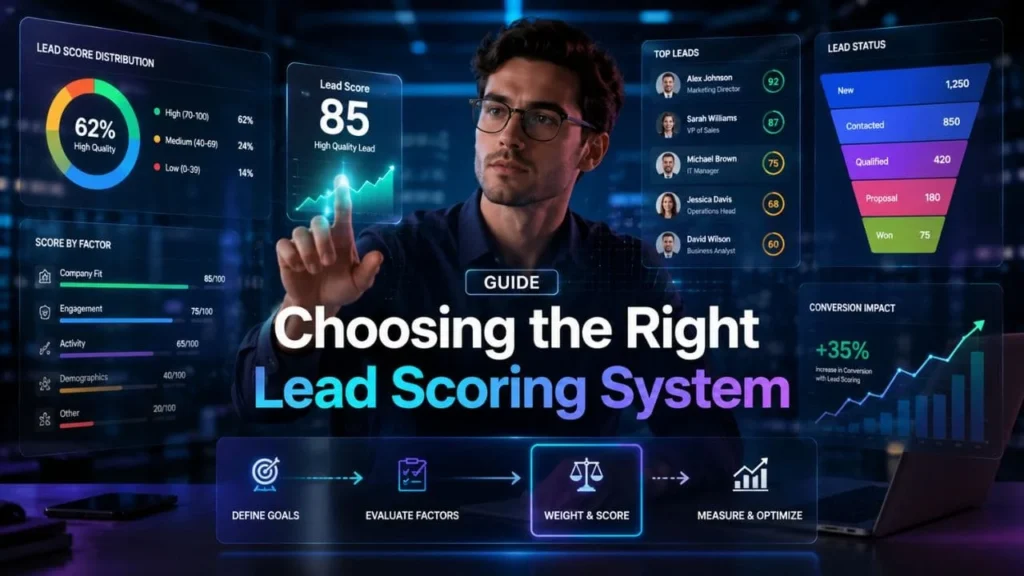
A lead scoring system should fit the business process. A company with a small sales team may need a simple CRM-based setup. A company with a large lead volume may need more advanced automation.
Before choosing a system, businesses should ask:
- How many leads do we receive each month?
- Where do our leads come from?
- Do we have enough CRM history?
- Do sales and marketing teams use the same data?
- Do we need real-time scoring?
- Can the team review and adjust scores?
- Does the system connect with email, calling, and CRM tools?
The right setup depends on the company’s sales cycle, lead volume, and data quality.
How Lead Scoring Software Supports Sales Teams
Lead scoring software can help businesses collect data, assign scores, update lead status, and send alerts when a prospect becomes sales-ready. By using AI lead scoring for better B2B conversion rates, companies can identify high-potential prospects more accurately and prioritize outreach based on buying intent.
Many tools can connect with CRMs, email platforms, website analytics, and automation systems. This helps teams avoid manual checking and gives salespeople a clearer view of which leads need attention.
Features to Look For
A good tool may include:
- CRM connection
- Custom scoring rules
- AI-based scoring
- Lead activity tracking
- Email engagement tracking
- Sales alerts
- Contact segmentation
- Reporting dashboard
- Lead source tracking
- Score history
The goal is not just to score leads. The goal is to help sales teams take better action at the right time.

Automated Scoring and Faster Follow-Up
Automated lead scoring helps teams react quickly when a lead shows strong interest. In B2B sales, timing can make a major difference. If a lead submits a form or visits a pricing page, waiting too long may reduce the chance of conversion.
With automation, a sales rep can receive alerts when a lead crosses a certain score. The lead can then be moved to a priority list, assigned to an agent, or placed into a specific follow-up sequence.
This is especially useful for companies that handle large volumes of leads from multiple sources.
MQLs, SQLs and Better Handover
Marketing and sales teams often use different lead stages. Marketing qualified leads are prospects who have shown enough interest to be nurtured or reviewed. Sales qualified leads are prospects that appear ready for direct sales contact.
A scoring process can help define the difference between both stages. When the score reaches a certain level, a lead can move from marketing review to sales follow-up.
This makes handover smoother and reduces confusion between teams.
Example Lead Stage Flow
- New lead enters the database
- Basic details are checked
- Engagement is tracked
- Score is assigned
- Lead is placed into a segment
- High-priority lead goes to sales
- Lower-priority lead enters nurturing
- Sales feedback improves future scoring
Improving the B2B Sales Pipeline
A healthy B2B sales pipeline depends on qualified opportunities. If the pipeline is filled with weak leads, reports may look good, but actual revenue may not improve.
Scoring helps clean the pipeline by separating active opportunities from cold contacts. This gives sales managers a better view of real demand.
How Scoring Improves Pipeline Quality
It helps teams:
- Remove poor-fit contacts from priority lists
- Give better leads faster attention
- Improve follow-up planning
- Create better nurturing segments
- Understand which campaigns produce quality
- Reduce wasted calls and emails
- Forecast sales activity more clearly
Better pipeline quality helps teams make better decisions.
AI for Sales and Marketing Alignment
AI for B2B sales can improve how marketing and sales teams work together. Marketing teams can see which campaigns bring stronger leads. Sales teams can see which contacts deserve attention first.
This creates better alignment because both teams use the same scoring logic. Instead of arguing over lead quality, teams can review data together and improve the scoring method.
Why Alignment Matters
When marketing sends too many weak leads, sales teams lose trust. When sales teams ignore leads without feedback, marketing cannot improve campaigns. A shared scoring process helps both teams understand what is working.
B2B Sales Automation and Campaign Efficiency
B2B sales automation helps businesses reduce repeated manual tasks. This may include assigning leads, sending follow-up emails, updating CRM stages, or notifying sales reps.
When scoring and automation work together, the sales process becomes more organised. High-priority leads can move faster, while early-stage leads can receive educational content until they are ready.
This does not remove the need for personal communication. It simply helps teams manage time better.
Using Analytics to Improve Sales Outcomes
Predictive analytics for sales helps companies study patterns from past activity and use them for future planning. It can help answer questions such as:
- Which lead sources bring better prospects?
- Which industries respond faster?
- Which behaviours appear before conversion?
- Which campaigns produce low-quality leads?
- Which follow-up timing works better?
These answers help businesses improve sales planning and lead handling.
Sales Funnel and Conversion Improvements
Sales funnel optimization means improving each stage of the buyer journey, from first contact to final conversion. Scoring helps by showing where leads are in the funnel and what type of follow-up they need.
A cold lead may need useful information. A warm lead may need a comparison or service explanation. A ready lead may need a call, proposal, or pricing discussion.
Conversion Rate Focus
Conversion rate optimisation is not only about landing pages. It also includes better lead handling, stronger follow-up timing, clear messaging, and better qualification.
When leads are scored correctly, sales teams can match their follow-up with the lead’s level of interest. This can improve B2B conversion rates because the right prospects receive the right attention.
Case Study: How a B2B Team Improved Lead Conversion
Background
A B2B service provider was receiving leads from website forms, email campaigns, calling data, and referral sources. The sales team had a large contact list, but every lead was treated almost the same.
Some leads were contacted quickly, while others waited for days. The team had no clear way to know which leads had stronger buying signals.
Challenge
The company faced three major problems:
- Sales agents spent too much time on low-response contacts
- Good leads were sometimes missed or delayed
- Marketing could not clearly identify which lead sources created better opportunities
The team needed a better way to rank leads before assigning them to sales agents.
Approach
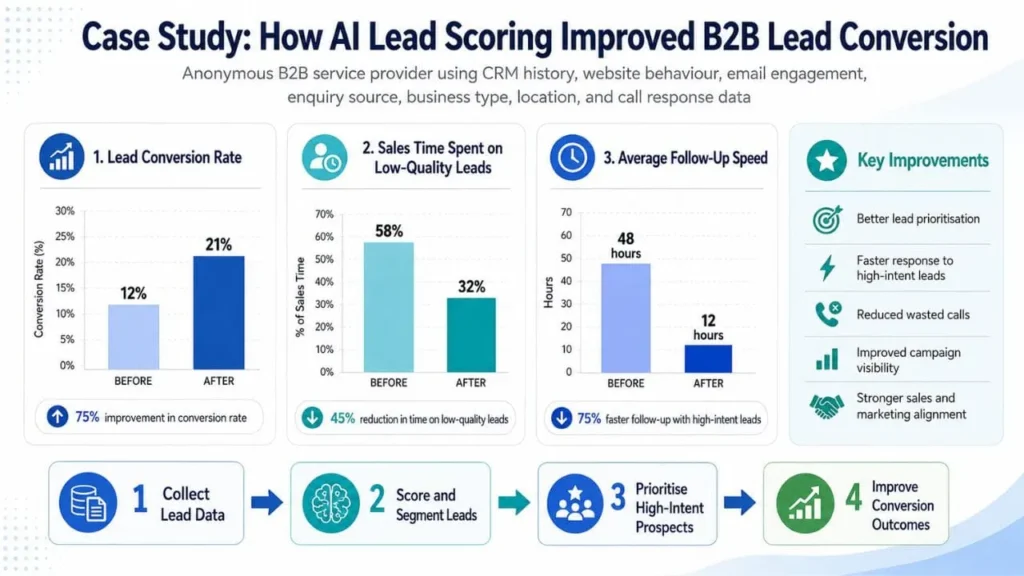
The company created a scoring process using CRM history, enquiry source, website behaviour, email engagement, business type, location, and call response data. Leads with stronger activity and better business fit were placed in a high-priority segment.
The team also reviewed old converted leads to understand common patterns. This helped them identify which actions and company details were linked with better outcomes.
Result
After applying the scoring process, the sales team became more focused. Agents started calling high-priority leads first. Lower-priority leads were added to nurturing campaigns instead of being ignored.
The company also improved reporting. Marketing could see which campaigns created better prospects, and sales could give feedback on lead quality. Over time, the team reduced wasted calls and improved follow-up timing.
Key Learning
The biggest improvement came from focusing on lead quality instead of only lead volume. The team did not need more random contacts. It needed a smarter way to understand which contacts deserved immediate attention.
Common Mistakes to Avoid
Using Outdated Data
Old contact information, wrong phone numbers, inactive emails, and missing company details can reduce scoring accuracy. Businesses should clean their data regularly.
Scoring Every Action Equally
Not every action has the same value. A pricing page visit may show stronger intent than a general blog visit. A form submission may matter more than an email open.
Ignoring Sales Feedback
Sales teams speak with leads directly. Their feedback can reveal whether scoring is accurate. Without this feedback, the scoring process may become disconnected from real results.
Depending Only on Automation
Automation can save time, but it cannot understand every human situation. Salespeople still need to check context before making final decisions.
Not Reviewing the Process
Buyer behaviour changes over time. A scoring process should be reviewed regularly to stay useful.
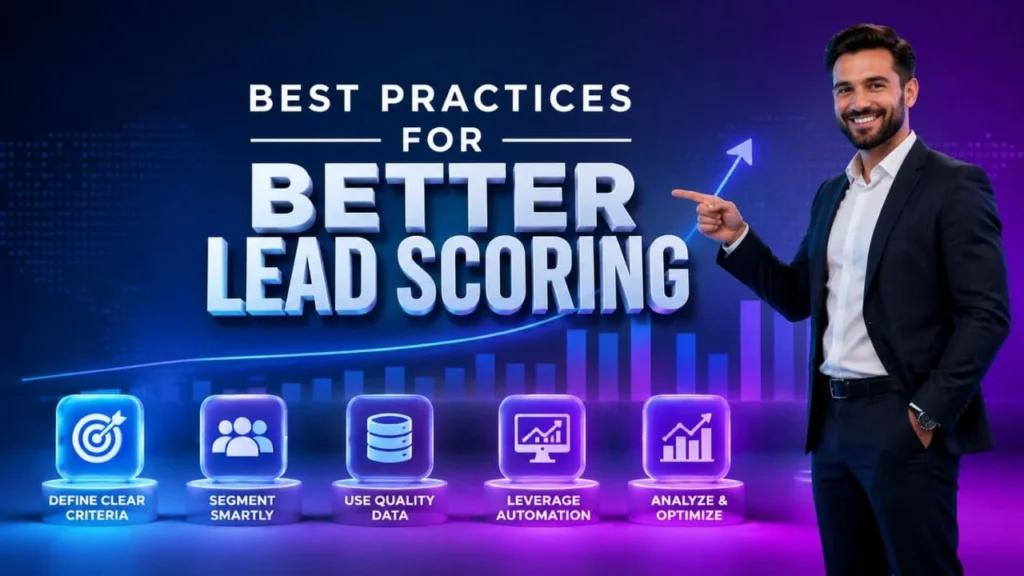
Best Practices for Better Lead Scoring
Define Your Ideal Customer
Start by defining which companies are the best fit. Look at industry, size, location, service need, and decision-making role.
Use Both Fit and Intent
A lead should not be ranked high only because it matches the target industry. It should also show real activity or interest.
Keep Sales and Marketing Connected
Both teams should agree on what makes a lead valuable. Regular feedback helps improve scoring quality.
Review Closed Deals
Past converted customers can show useful patterns. Study what they had in common before they became customers.
Segment Leads Properly
Do not send every lead to sales immediately. Some need direct follow-up, while others need nurturing through emails, content, or future campaigns.
Track Results
Measure how scored leads perform. Check conversion rate, response rate, call success, meeting bookings, and sales outcomes.
FAQs
Q: What is lead scoring in B2B marketing?
Ans: Lead scoring in B2B marketing is the process of ranking prospects based on their fit, behaviour, engagement, and chance of becoming customers. It helps teams decide which leads should receive faster follow-up.
Q: Why is AI useful for scoring leads?
Ans: AI is useful because it can study large amounts of data and find patterns that are hard to detect manually. It can compare new leads with past sales outcomes and help teams prioritise better prospects.
Q: How does scoring improve sales productivity?
Ans: Scoring improves productivity by helping sales teams focus on leads that are more likely to respond or convert. This reduces time spent on weak contacts and improves follow-up planning.
Q: What data is needed for better scoring?
Ans: Useful data includes company details, website activity, form submissions, email engagement, call response, CRM history, lead source, and past conversion records.
Q: Can small B2B businesses use scoring?
Ans: Yes. Small businesses can start with simple scoring rules based on form fills, email clicks, company type, and sales feedback. As they collect more data, they can improve the process.
Q: How often should a scoring process be updated?
Ans: A scoring process should be reviewed regularly, especially when campaign performance changes, lead quality drops, or sales teams notice that high-scoring leads are not converting.
Q: Does scoring replace salespeople?
Ans: No. Scoring helps salespeople decide where to focus first. Human communication, judgement, trust-building, and negotiation are still important in B2B sales.
Q: What is the difference between a cold lead and a high-priority lead?
Ans: A cold lead has little or no sign of interest. A high-priority lead shows stronger fit, engagement, or buying signals and should usually receive faster follow-up.
Conclusion
Better lead management is not about contacting every prospect with the same effort. It is about understanding which leads are more likely to move forward and which leads need more nurturing.
For B2B teams, AI lead scoring can support smarter lead ranking, faster follow-up, and better use of sales time. It helps teams study behaviour, fit, engagement, and past sales patterns before deciding what action to take.
When used with clean data, regular sales feedback, and clear qualification rules, this approach can support stronger B2B conversion rates and a healthier sales process. For businesses that rely on calling data, email outreach, and lead generation campaigns, better scoring can turn large lead lists into more organised and useful sales opportunities.