Purchasing B2B information may either fortify your sales funnel or silently drain your advertising budget. Most companies have invested in B2B contact information with the hope of achieving higher conversion rates, but often end up with high bounce rates, unresponsiveness, and wasted time for their agents. The distinction usually reduces to a single factor, which is verification.
When you intend to purchase B2B leads or invest in any business email database, you should have a clear system that you use to verify the accuracy, compliance, and relevance of data. This guideline explains how to check B2B data before purchase, what to consider in B2B data suppliers, and how to protect your investment.
Table of Contents
The importance of verifying B2B Data
Outbound sales, email marketing, and call center campaigns are based on B2B information. When the information is true, your group reaches out to decision makers. In the case of being outdated or incomplete, performance declines.
Weak quality of B2B contact information may cause
- High email bounce rates
- Poor connection rates in cold calling.
- Reduced sender reputation
- Regulatory risks on data protection laws.
- Wasted marketing budget
In case you would like to get the same results every time, you need to consider the process of data verification as a routine to be followed when acquiring any B2B database.
What Is B2B Data and What It Should Contain
You must know what you are really purchasing before you check B2B data
B2B data usually includes:
- Business email addresses
- Direct phone numbers
- Company name
- Industry
- Company size
- Location
- Job title of decision makers
Good quality B2B leads are not simple contacts. They provide updated, relevant, and segmented information that can assist your team in reaching the right audience.
When purchasing B2B leads, it is always important to check whether these are raw data or confirmed B2B contact data.
Measures of Importance Before Purchasing B2B Data
In assessing the most efficient B2B data suppliers, pay attention to quality indicators that can be measured instead of general statements.
Accuracy Rate
Enquire the data provider on his or her alleged data accuracy percentage. The reliable data vendors of B2B data should spell out:
Average accuracy rate
- Expected bounce rate
- Validation method used
Watch out when a provider claims to be 100 percent accurate. There is no error-free database. More credible and open numbers are more believable.
Data Freshness
Information is also obsolete as there is a constant change in jobs and companies. Ask:
What is the frequency of updating the B2B database?
- The re-verification of job titles.
- The frequency of phone number verification.
- New statistics enhance the response rate and save your domain reputation.
Source Transparency
It is important to have the knowledge of the data source.
Enquire whether the B2B contact information is:
- First party collected
- Compiled third-party sources.
- It was constructed based on government databanks and business directories.
Ethical practices and less compliance. Transparent sourcing will ensure reduced compliance issues.
Segmentation Options
Targeting is an important aspect of lead generation. Is the provider providing:
- Segmentation on the basis of industry.
- Geographic filters
- Company size filters
- Decision maker targeting
B2B data that is well segmented improves the relevance and quality of leads of the campaign.
Sequence of Verifying B2B Data
It is important to know how to check B2B data prior to purchase to avoid costly errors.
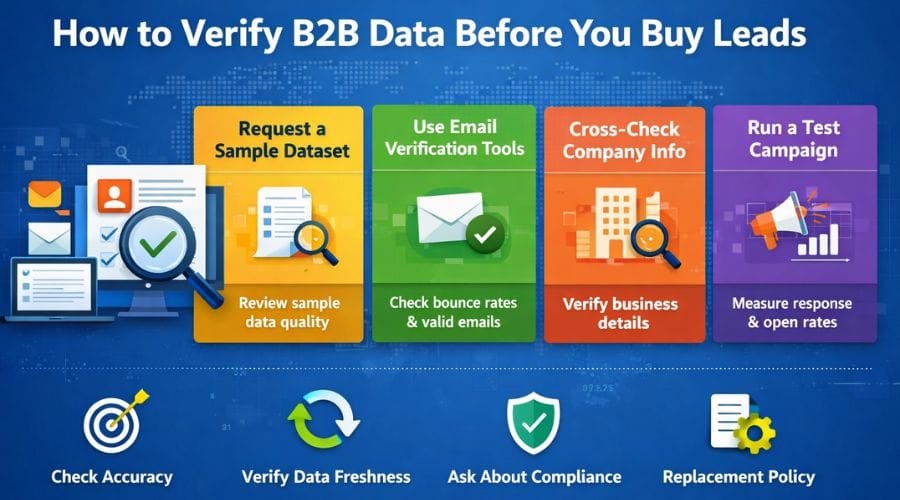
Request a Sample Dataset
Request a small sample before purchasing a full-size one. Review:
- Email format consistency
- Presence of company domains
- Job title accuracy
- Industry relevance
A sample can give you an opportunity to know whether the data is adhering to your campaign objectives.
Apply Email Checking Softwares
Check the email list of the samples by passing it through an email verification tool:
- Valid mail servers
- Active domains
- Risky or catch-all addresses
The step can assist you in determining the bounce rates and general data accuracy.
Cross Check Company Information
Confirm company information by:
- Official company websites
- Professional networking services.
- Business directories Public.
Determine whether the listed jobs and companies are accurate or not.
Carry out a Small Preliminary Test Campaign
Rather than carrying out a wide-scale campaign, pilot the information using a small-scale outreach program. Monitor:
- Open rates
- Reply rates
- Call connect rates
The true quality of B2B leads can be discovered even after a brief test.
Review Replacement Policy
The data providers tend to provide reliable B2B data that would typically include:
- Replacement of invalid contacts with data.
- Defined refund terms
- Clear service agreements
A replacement policy expresses trust in the quality of data.
When Purchasing B2B Leads: Red Flags
There are warning signs that should automatically create an alarm.
Watch for:
- Very low prices relative to the industry rates.
- No sample data offered
- Lack of transparency regarding sources of data.
- General answers regarding the accuracy rates.
- No mention of compliance
Purchasing unverified B2B email lists is usually followed by losses in the long run.
Accessibility and Legal Concerns
B2B lead generation takes into account compliance. Regulations on data protection, like GDPR and CAN-SPA, M mandate the responsible use of data.
Confirm before purchase B2B contact data:
- The adherence to legal guidelines in the collection of data.
- In case there are legal grounds to process business contact data.
- The mishandling of opt-out requests.
Good data management safeguards your company’s image and lowers the chances of legal liability.
The B2B Data Poor Quality Cost
Bad data is usually concealed.
It includes:
- Time in invalid contacts of sales teams.
- Marketing funds on undelivered mail.
- Lower conversion rates.
- Less developed campaign performance.
Conversely, validated B2B data enhances targeting, response rates, and helps to increase the return on investment.
Mathematically speaking, it is financially sound to invest in high-quality B2B leads in the long term.
Questions to Ask Before Finalizing a B2B Data Purchase
The following are the questions to be asked before any agreement is signed:
- Frequency of updating the B2B database?
- What is your bouncing average rate?
- Brings industry specific segmentation.
- How is your policy on the replacement of data?
- What do you do to ensure that you have adhered to the laws of data protection?
Clarity helps you to make informed decisions.
Final Thoughts
When you are using outbound sales or email marketing, the outcome would rely heavily on the quality of data. Checking of B2B information prior to its purchase is not discretionary. It is a realistic measure that safeguards your marketing investment and enhances the performance of lead generation.
By spending a few seconds to ensure the accuracy, freshness, segmentation, and compliance of data, you limit the risk and enhance the campaign results. Rather than targeting cost alone, target validated B2B contacts’ information that corresponds to your target market.
Good data practices result in improved relationships, greater response rates, and steady business growth.
Frequently Asked Questions
How to check B2B information to make purchases?
The most effective solution will involve asking a sample data, a tool of email verification, a cross check of company information, and a mini test campaign. These measures will provide you with an accurate image of data.
To what extent should B2B data be accurate?
Accuracy of most reliable B2B data providers is between eighty five to ninety five percent. Always ensure by doing independent testing, before large scale use.
What is the value of the freshness of data in B2B lead generation?
The positions and the specifics of the company evolve rather often. New data enhances the rates of connection and lowers the rates of email bounces.
Is purchasing B2B email listings legal?
Purchase of B2B data is legal provided that it is done in accordance with the relevant data protection laws and appropriate use policies. Always ensure practices of compliance are adhered to prior to buying.
What will be the impact of bad quality of B2B data on my business?
Having bad data will lower the results of a campaign, burn your marketing money and your spam score. These problems can be avoided through verification of data prior to purchase.