When it comes to contacting consumers via calling campaigns, it does not only take having access to a USA B2C list. It also requires a proper comprehension of Do Not Call compliance. Training businesses that fail to take this step expose themselves to legal dangers, wastage, and a lack of trust. Cleaning a USA B2C list to make it compliant with DNC regulations can ensure that contacting is legal, respectful, and productive.
This guide describes the significance and the functionality of DNC scrubbing, along with the execution of the procedure in a way that is no longer complicated to use.
Table of Contents
Knowledge of the DNC Compliance in the United States
Do Not Call Registry is regulated at the federal level, and it is backed by other state-level regulations. It gives the customer a chance to accept or reject unsolicited sales calls. Every organization that makes use of consumer calling data is bound to these rules when dialing.
DNC compliance applies to
• Telemarketing teams
• BPO call centers
• Sales departments
Outbound calling campaigns can be applied to organizations that operate calling campaigns.
Failure to comply with these regulations may lead to fines and limitations, which may have an impact on the long-term performance.
What Can It Mean to Scrub a USA B2C List
The method of matching phone numbers in a USA B2C list to suppression databases is known as scrubbing. The aim is to call and eliminate contacts that are unnecessary.
This is to enhance the accuracy of the lists, and the data complies with the existing calling rules.
Major Suppression List types
The National Do Not Call Registry
• State-level Do Not Call lists
• Internal do-not-call records
• Refusal and permission lists.
By combining all of these sources, an obedient and workable calling list is achieved.
The importance of DNC Scrubbing on B2C Calling
USA B2C List scrubbing is not a mere regulation. It also enhances the quality of the campaign and the response rates.
Benefits include
• Reduced legal exposure
• Better data hygiene
• Improved contact relevance
• Better customer confidence.
When calling is done to authorized numbers only, the resources will be used more effectively.
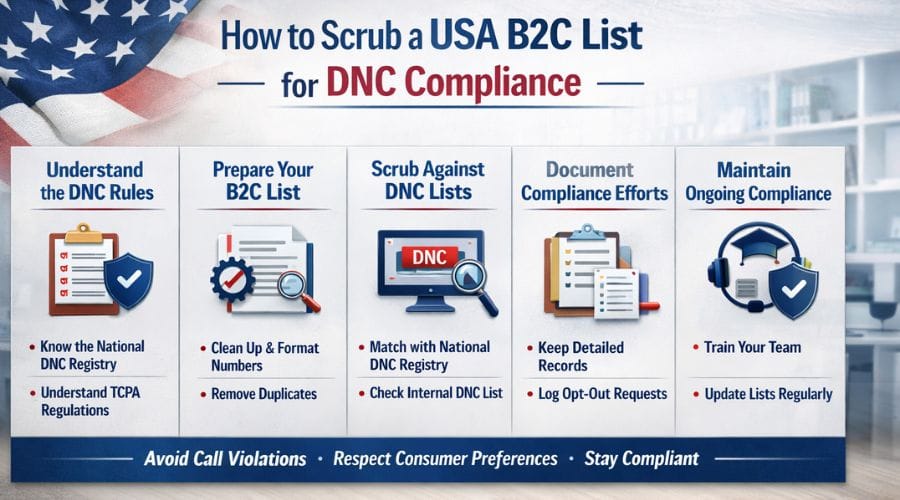
How to Scrub a list of USA B2C List to meet the DNC Compliance
Prepare the B2C Contact Data
The data should be organized to run any checks.
This includes
• Checking of phone numbers format.
• Removing duplicate entries
• Making sure that all the necessary fields exist.
The better the input data is, the better the outcomes of scrubbing will be.
Check Numbers. It is verified against the National DNC Registry
The main database of compliance is the National DNC Registry.
Organizations must
• Add the list using approved types.
Each match number should be compared to the registry.
• Determine limited contacts.
This measure will make sure that the federally provided numbers are not included in the calling campaigns.
Included Internal Do Not Call Records
Internal suppression lists are also significant.
They include
Numbers that opted out.
• Contacts identified in outreach before.
• Records deleted as a result of complaints.
The use and preservation of internal lists demonstrate responsible data management.
Discuss Wireless and Landline restrictions
There are various rules governing various phone numbers.
More consents may be needless where wireless numbers are concerned. The determination of the types of numbers during scrubbing can help avoid unintended violations.
Record and Store Scrubbing Activity
Compliance accountability is supported by documentation.
Important records include
• Date of scrubbing
• Source of suppression data
• Version of the list used
Keeping logs will enable the organizations to prove compliance in the event of need.
Instrumentation involved in B2C List Scrubbing in the USA
Big data cannot be scrubbed manually. Automated solutions are used by most organizations.
Efficient tools typically provide
• Batch processing support
• Regular database updates
Workflow- It has options that can be integrated.
• Clear reporting features
Automation allows consistency and minimizes human mistakes
Best Practices to Continued DNC Compliance
Compliance is not a single exercise. Rules and tastes of consumers are ever evolving.
Best practices are suggested as including
• Washing lists prior to each campaign.
• Frequently updating suppression information.
• Examining federal and state guidelines.
• Making teams aware of calling rules.
Unity is important in having compliant operations
List scrubbing has common challenges associated with DNC
The organizations usually encounter problems that diminish performance.
These include
In the past, the databases used for suppression have been outdated.
• Ineffective records are prepared intermittently within the company.
• Irregularities in scrubbing schedules.
• Phoning issues: lack of classification and misclassification of phone numbers.
These challenges may be tackled to enhance compliance and performance.
Legal and Ethical Considerations
DNC regulations are aimed at safeguarding consumer choice. Ethical outreach is promoted by respecting those preferences.
List responsibility consists of
• Responding promptly to opt-out requests.
• Not making unnecessary calls to blocked numbers.
Treating consumer data with care: This is essential for protecting consumer data and is a key task in any business data-handling setup. Treating consumer data with care: This is a fundamental aspect of data privacy of consumer information and a trademark activity in any business data-management system.
Sustainable outreach issues are based on ethical practices
Frequently Asked Questions
What should be the frequency of DNC compliance of a USA B2C list?
Before each calling campaign, lists are to be scrubbed. This makes sure that the latest suppression updates are used.
Is DNC scrubbing relevant in text messaging?
Yes. The promotional outreach also consists of many DNC and consent rules applicable to messaging campaigns.
Does the national registry differ from state Do Not Call lists?
Yes. The national registry is supplemented by other rules and databases in some states that have to be consulted.
What will be the result in case a restricted number is called accidentally?
There are still penalties associated with unintentional calls. Risk reduction is facilitated by proper scrubbing and documentation.
Is the inner do not call data obligatory?
Yes. Internal requests on any opt-out request should be accepted, and documents should be kept.
Conclusion
Scrubbing a USA B2C list to make it legal and responsible is a starting point for the legal and responsible calling campaigns. It safeguards organizations against regulatory problems and enhances the quality of data and outreach focus. Campaigns can be maintained to ensure that businesses operate within set procedures, proper records, and best practices without involving any undue complexities.
In case DNC compliance is incorporated into the regular data management process, calling operations are effective and respectful.