
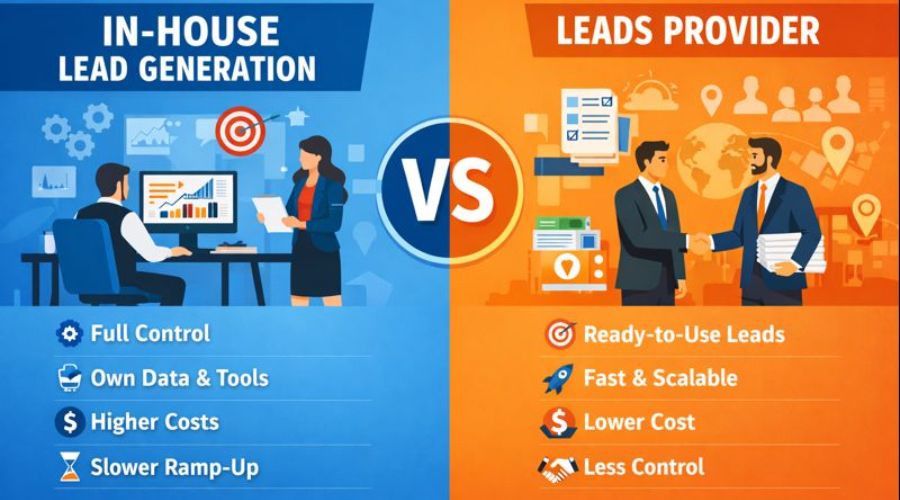
Lead generation is at the center of business development, sales pipelines, and the constant growth of businesses. In a B2B or B2C environment, the source method applied may have a direct impact on conversion rates and stability of revenue, as well as the productivity of the team.
When many businesses come to an airport, they have reached the stage of choosing whether to develop in house lead generation process or collaborate with a dedicated lead provider. Each of the two options comes with its strengths and weaknesses. The decision will be the right one based on your objectives, budgeting on the internal resources, and schedule.
This guide lists the main differences of this guide in a straightforward and approachable manner so as to be able to choose the best that suits your business requirements.
Table of Contents
What Is In-House Lead Generation
In-house lead generation is the control of the whole process of lead acquisition in-house. Your team is the one that is planning execution, monitoring, and optimization without making use of an external data provider.
Principles of Lead Generation with In-House Works
A typical internal lead generation system contains
- Marketing and sales congruence.
- Head research and data collection.
- Inbound and outreach activities that are content-based.
- Management of CRM and lead tracking.
- Continued performance review.
Companies that prefer this path tend to invest in the tools platform and qualified personnel to keep the flow of leads.
Benefits of Working With a Leads Provider
- Complete messaging and targeting control.
- One-sided ownership of lead data.
- Close brand voice congruency.
- Simplified long-term strategy customization.
Weaknesses of In-House Lead Generation
- Increased operations and manpower expenses.
- Time-consuming installation and maintenance.
- Constant training and updates are needed.
- Sluggish performance at the initial stages.
In businesses with small resources internally, this method may end up being strenuous in the long run.
What Does a Lead Provider Appear To Provide
A lead provider is an individual who provides ready-to-use contacts, which are based on a targeting criterion. These data providers center their attention on the acquisition of verifying and segmentation leads to enable the sales teams concentrate on outreach and conversion.
The way Leads Provider serves Business
- Leads providers normally provide.
- Authenticated contact details.
- Location-specific or industry-specific data.
- B2B and B2C lead lists
- On-demand, scalable data delivery
This model enables the firms to have leads without having to take the whole acquisition process under their management.
Advantages of Working with a Leads Provider
- More timely access to qualified leads.
- Reduced internal workload
- Predictable lead supply
- Scale campaign flexibility.
Limitations to Consider
- Quality is dependent on the provider process.
- Reduced ability to control the source of raw data.
- Needs to be in agreement on the data expectations.
It will be necessary to pick a trustworthy provider in order to maintain consistency and relevance.
In-House Lead Generation vs Leads Provider Comparison
Cost Efficiency
The continued cost in the generation of leads in the house is in the form of salaries, tools, and data management systems. A lead provider tends to have a more convenient cost structure that helps businesses to make budgets more effectively.
Lead Quality and Accuracy
Internal teams will have the capacity to hone targeting as time passes, but data will rely on internal knowledge. Lead providers usually have special processes of verification to keep the data up to date and relevant.
Speed to Market
Development of an internal system is a time-consuming affair. Lead providers provide real-time access to information that contributes to the expeditious execution of campaigns.
Scalability
Sudden growth phases may be a challenge to in house teams. Lead providers enable companies to control the volume of leads according to the existing demand.
When In-House Lead Generation Makes Sense
– When It Makes Sense.
Lead generation in-house can be appropriate in cases where
- You possess a qualified marketing and data team.
- The need to have brand control in the long term.
- The budget provides a continuity of operational costs.
- Volume requirements of lead are not fluctuating.
The strategy is in favour of a business that emphasises ownership of internal processes.
When a Leads Provider Is a Good Idea
- When it is best to work with a lead provider is usually when
- It needs access to lead as soon as possible.
- Constant data flow is required in sales teams.
- There are limited internal resources.
Targeting of campaigns necessitates geographic or industry-specific targeting.
This option is adopted by many developing businesses that do not need to increase internal personnel, so that the momentum is not lost.
Adaptation of a Hybrid Lead Generation Approach
There are those businesses that have integrated both approaches so as to have a balance between control and efficiency.
How a Hybrid Model Works
- Internal teams are involved in nurturing and strategy.
- Data is supplied with the help of lead providers.
- The sales teams are presented with constant feeds of leads.
This strategy gives it some flexibility and lowers the pressure of operations.
Key Metrics to Measure Lead Generation Success
Whichever approach is adopted, performance tracking is a necessity.
Important metrics include
- Lead accuracy and validity
- Profit level at each sales stage.
- Cost per lead
- Information applicability to the target audience.
Regular review contributes to improving the decisions on lead generation in the long run.

The way to select the proper lead generation direction
Before making a decision, ask yourself
- Are we in need of long term and short term need to use of lead?
- Are we internally skilled and equipped?
- Is scalability a priority
- What is the level of data accuracy to which we are expecting?
Definite solutions will help to bring your strategy in line with business objectives.
Frequently Asked Questions
Is a combination of both approaches possible?
Yes,s a mixture is an in-between approach that will enable businesses to achieve a balance between efficiency in control and scalability.
Is it possible for businesses to change from in-house to outsourced lead generation by the businesses?
Yes, there are lots of businesses that change their strategy according to the resources of the stage of growth and sales goals.
What strategies help businesses to verify the quality of leads provided by a given supplier?
Through checking the sources of data verification procedures and the frequency of updating prior to engagement.
Do lead providers fit B2B and B2C businesses?
There are, in fact,t numerous providers of both B2B and B2C data in various industries and geographies.
Final Thoughts
The decision to go in-house or to use a lead provider is not concerned with finding the best option in the whole situation. It is a decision of picking what fits within your business model, schedule, and capabilities.
Lead quality consistency and alignment of growth are key aspects that, when given priority by businesses,s will help them develop a sustainable strategy which helps them to maintain clear sales performance and clarity of operations in the long run.